Stanford's AI Just Designed 16 Brand-New Viruses From Scratch
Stanford's Evo 2 model designed 16 working bacteriophages to fight antibiotic-resistant bacteria — but biosecurity experts warn the same tool could be misused.

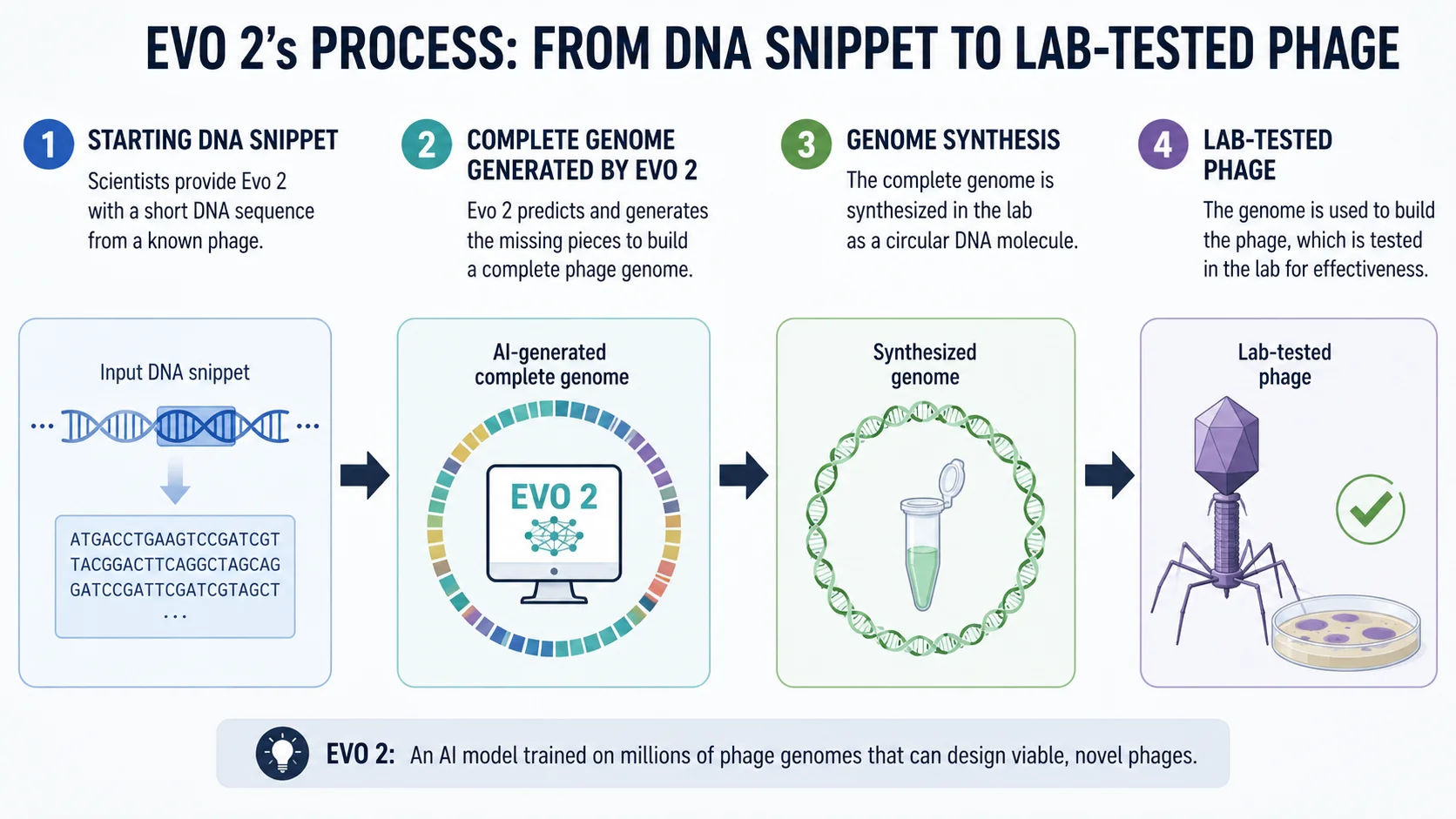
Stanford researchers used a generative AI model called Evo 2 to design complete viral genomes from scratch — and 16 of them, once synthesized in a lab, turned into fully functional bacteriophages capable of killing E. coli, including strains already resistant to natural viruses. The findings were published in the journal Science.
Why You Should Care
This is genuinely good news wrapped in an unsettling detail. The actual achievement — AI designing new "phages" that could become a fresh weapon against antibiotic-resistant infections — matters to anyone who's ever worried about a hospital-acquired infection that doesn't respond to standard drugs. The unsettling part is that Evo 2 is open-source and free to download, meaning the same technology built to design helpful bacteria-killers could theoretically be pointed at something far more dangerous, and biosecurity experts are already sounding the alarm about the lack of any legal requirement to screen for that risk.
Complex to Simple
Evo 2 works like a highly specialized autocomplete, but for DNA instead of text — the same way a language model predicts the next word in a sentence, Evo 2 predicts the next piece of genetic code, trained on over 9 trillion nucleotides from more than 128,000 genomes. Researchers gave it a small starting snippet of a known virus and let it write an entire new genome from there, the biological equivalent of feeding an AI the first paragraph of a novel and letting it write the rest of the book — except in this case, the "book," once printed (synthesized), turned out to actually work as a living virus.
What Both Sides Are Saying
Stanford's research team, led by Brian Hie, frames this as a major step toward new antibiotics, with plans to target drug-resistant threats like MRSA and hospital-acquired Pseudomonas infections next — and Hie has argued that naturally occurring pathogens, which are far easier to access and produce, pose a greater practical risk than AI-designed ones. Biosecurity researchers, including Johns Hopkins' Center for Health Security, disagree with that risk assessment, calling for strict new laws requiring screening before this kind of generative technique is applied to any pathogen capable of infecting humans, animals, or crops.
What's Next
Watch whether U.S. lawmakers move on biosecurity legislation targeting AI-designed genomes — Evo 2's open-source availability on platforms like NVIDIA's BioNeMo means any regulatory response will need to grapple with technology that's already freely downloadable, not hypothetically dangerous someday.