The Earthquake Wasn't the Deadliest Part. What Happened Next Was.
A 7.1 earthquake hit Japan, but a mall explosion an hour later proved deadlier.

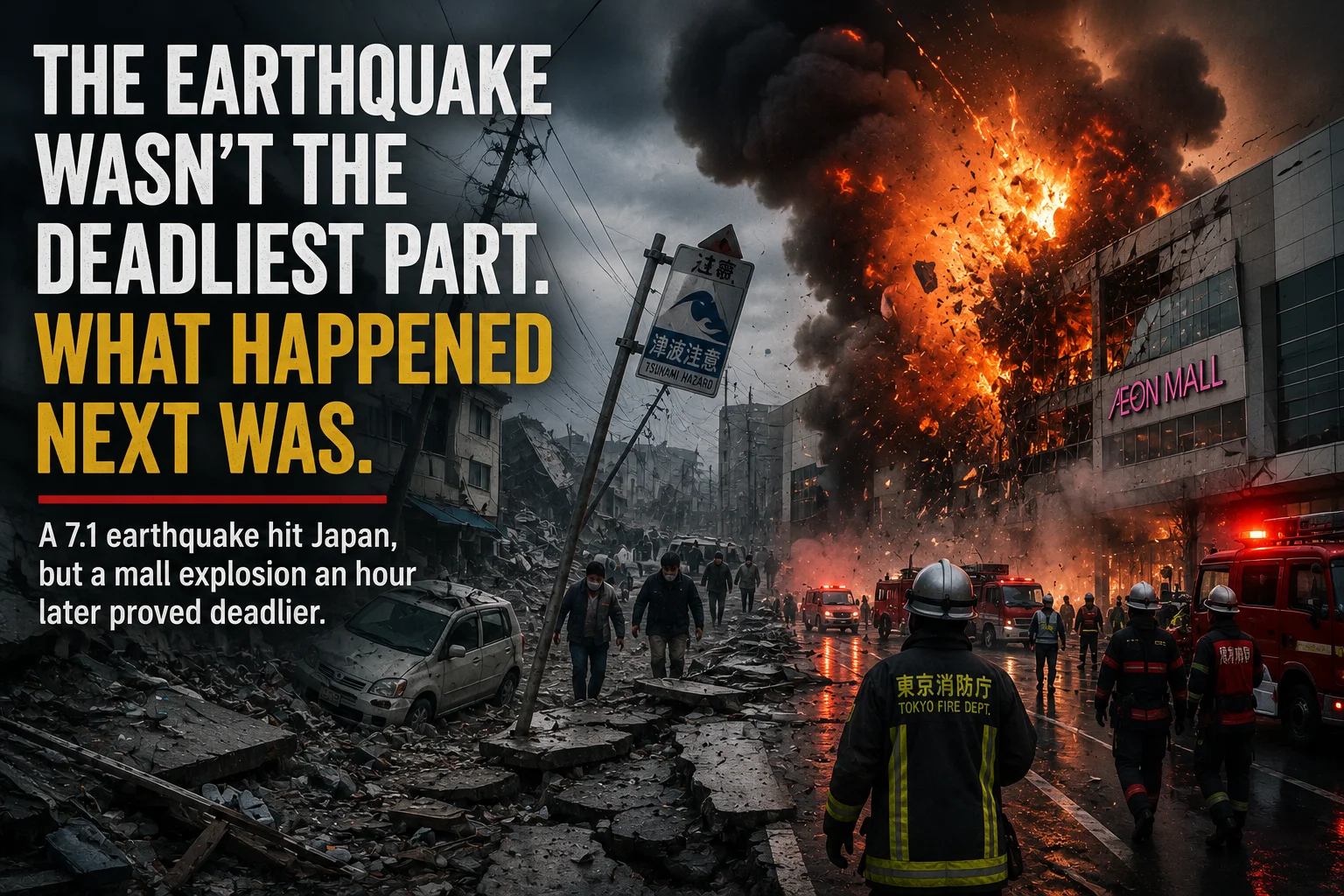
A 7.1 Earthquake Hit Japan. Then a Mall Exploded an Hour Later. Deck: A powerful quake in Kumamoto Prefecture killed at least 18 people — but it was a gas explosion at a packed shopping mall, nearly an hour after the shaking stopped, that turned the disaster deadlier.
A magnitude 7.1 earthquake struck Japan's Kumamoto Prefecture on the southern island of Kyushu on Tuesday afternoon, and for the roughly 3,000 people inside the Aeon Mall in Kashima Town, the worst moment didn't come during the shaking — it came about 50 minutes later.
By the time the quake hit, mall staff had already begun evacuating shoppers to the parking lot; all customers were out by 5 p.m. local time. Then, around 50 minutes after the tremor, an explosion — believed to be caused by a gas leak, though not yet officially confirmed — tore through part of the building. The blast blew off exterior walls, exposed steel framework, and caused the mall's second floor to collapse, trapping an unknown number of the roughly 2,700 people who worked there.
Aeon Mall's president, Akio Yoshida, told reporters the explosion happened after customers had already left the building. As of the latest count, at least five deaths were confirmed at the mall site, with three more people still missing. A short distance away, a Nippon Paper Industries factory in Yatsushiro also suffered severe damage — a collapsed chimney killed several workers, with more still unaccounted for.
Japan's Prime Minister, Sanae Takaichi, confirmed at least 13 deaths from the disaster overall the day after the quake, warning the toll was likely to climb; more recent reports put the total at 18 or higher, with over 60 injured. The Japan Meteorological Agency briefly issued and then lifted a tsunami advisory for parts of Kyushu, and the quake also triggered at least eight separate fires and forced a temporary closure of Kumamoto Airport.
Tens of thousands of homes across the region remain without power or running water as rescue crews — soldiers, firefighters, and emergency workers — continue combing through the rubble in sweltering summer heat, hampered at times by the smell of gas and the risk of aftershocks.
The mall itself carried particular symbolic weight for the region: it had been rebuilt after Kumamoto's last major earthquake, a magnitude 7.3 disaster in 2016, with the redevelopment specifically designed to include seismic reinforcements meant to make the complex more resilient. That it was still catastrophically damaged — this time by a secondary explosion, not the quake itself — is likely to raise new questions about how Japan plans for compounding disasters, not just the initial shock.